











At booth 5-01 in Foshan, we parked a blue-and-silver BMW M2 beside a dark blue M3 Touring, a purple M4 and a silver Corvette C6. All four wore their full REVOZPORT kits. The M2 and Corvette had raised wings above their rear decks, while the two Street builds carried their upper rear treatments closer to the body. At the front, even the parts that occupied the same position had different jobs in the design. The M2 splitter put a hard line under a square bumper. The Corvette’s swept around a low, rounded nose.
That was the comparison we took away from Foshan APAxpo 2026 at the Tanzhou International Convention and Exhibition Center. Put the four cars under the same lights and you can follow how each kit deals with three things: the shape of the front bumper, the space between the wheels and the place where the body ends.
BMW M2 G87 Race: the work starts below the grille
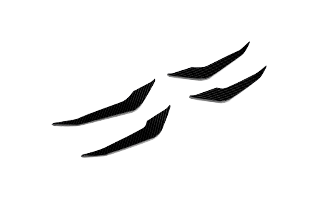
The number 62 livery draws your eye toward the doors, but the Race kit changes the M2 most visibly at its outer corners. The G87’s bumper gives the kit a blunt, upright face to work with. The splitter extends forward underneath it, making a horizontal ledge below the central opening. At the sides, the small canards give the corners individual edges above that ledge. Together, those pieces give the nose enough definition to remain readable against the silver reflections and jagged blocks of blue.
The profile also shows why a splitter and a front lip can read differently, even when both sit at the bottom of a bumper. On the M2 the projection is visible beyond the nose, and there is a distinct dark face above it. On the Touring the lip stays closer to the turn of the bumper. You see its thickness most clearly at the corner. This comparison is about the shape of the installed parts. The photographs place them in relation to the bumper and wheels, which is the level of detail a parts catalog alone can miss.
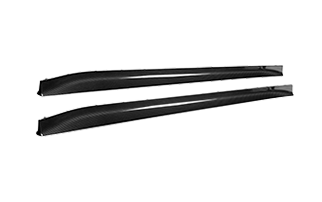
Behind the front wheel, the fender treatment creates a dark break between the arch and the door. The low side skirt picks up again underneath it and carries that line along the rocker. There’s a change of direction here that’s easy to overlook. The fender draws your eye up around the tire, while the skirt takes it back toward the rear axle. On a short coupe like the M2, that junction is where an extended splitter can start to look like a separate attachment. The skirt gives its outer edge somewhere to lead.

At the back, the Race wing pulls away from the trunk. The gap under the blade is a big part of the shape, especially in profile. Our close-up shows the carbon blade, the slotted endplate and the upright that curves over the top of the blade. These are three parts you might take in as one black shape from across the aisle. Up close, the horizontal blade and the almost vertical endplate tell you why this assembly has such a distinct silhouette. The G87 M2 Race Program brings that wing together with the front aero, fenders, skirts and rear diffuser. It’s the spread of the parts around the car that makes number 62 recognizable from either end of the stand.
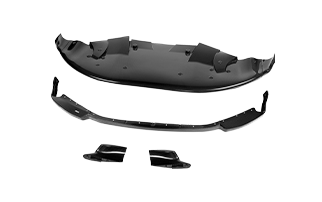
If you’re building up the front of a G87, the carbon fiber Race Splitter & Air Dam is the assembly beneath the bumper. The bumper canards are listed separately, as are the hood, hood strakes and front fenders. That distinction helps when you’re using number 62 as a reference. The small blades beside the outer bumper openings and the broad surface beneath the nose are different products.
At the other end of the car, the catalog breaks out the rear diffuser below the bumper and the adjustable Race Rear Wing above the deck. The close-up in this section is of the wing assembly. If you’re researching installation, open the guide for the individual part you’ve chosen. The splitter, canards and wing each have their own guide.
BMW M3 Touring G81 Street: working with a long roof
Our partner’s M3 Touring shares the tall grille shape of the M4 next to it. Below the grille, the front lip gives the two sides of the bumper a common lower edge. From the front corner, you can see the lip turn up around the outer intake before giving way to the front wheel. The carbon also sits against a different surface here: the blue body finish scatters the overhead light, while the glossy lip reflects it in a thin band along the floor.

The side skirt has a different visual job on the Touring. The rear doors and the long roof make the bodywork above the skirt read as one continuous side. A consistent lower edge gives that expanse a clear boundary. It also lets the kit look continuous when the car is seen from standing height, where the lower front opening is partly hidden and the side skirt is easier to pick out. A fender detail can be conspicuous in a close shot. The skirt does most of its visual work from farther away.
At the back, the layout follows the wagon’s structure. The upper spoiler extends the edge of the roof above the hatch glass. Lower down, the diffuser finishes the bumper around the exhaust outlets. With the tall hatch in between, the two carbon treatments occupy opposite ends of a broad vertical surface. That arrangement is specific to the wagon. If you’re working on a G81, the M3 Touring Street collection gives you the parts designed around that hatch and bumper.
There are two ways to approach the Touring’s parts list. If you want to carry the carbon line around the lower body, look at the front lip, side skirts and rear diffuser together. If you want to change the wagon’s profile from the rear, the G81 carbon fiber Roof Spoiler is the piece above the hatch. The collection also lists a hood, front fenders and stainless steel tailpipe finishers. Those are separate choices, so a buyer can decide which exterior details to change after settling the lower treatment.
BMW M4 G82 Street: bringing the front and rear together
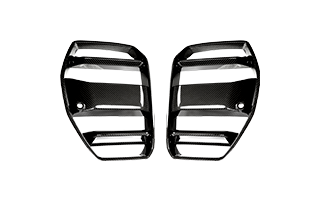
On our purple M4, the front lip has a similar relationship to the floor, but the dark pieces above it read differently. The opening in each outer corner moves the eye outward across the bumper, and the purple strip between the grilles keeps the center upright. The low lip connects those shapes at their base. In the straight-on view below, you can see how little of the body needs to be black for the nose to read as a whole. The purple still carries across the main painted surfaces, right down to the edge of each opening.

Move around the corner and the upper and lower halves start doing different things. The hood and fender lead toward a single long door, and the side skirt follows that door at a shallow angle. Above it, the roof is already falling before it reaches the rear wheel. That leaves the trunk as a short second surface beyond the rear glass. The same dark lower line that makes the Touring look long and level makes the M4 look narrower toward the tail, because there’s less body above it.
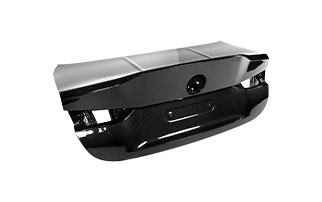
The G82 M4 Street collection offers two ways to work with that trunk. An add-on spoiler changes the trailing edge while retaining the original trunk lid. A replacement lid changes the panel itself. For a car you’re building in stages, that’s a more useful distinction than which option looks taller from an isolated rear view. One decision is about the edge of a panel you already have. The other is about the entire surface between the rear glass and the tail. In either case, the side skirts and diffuser still carry the lower line established at the front.
The G82 carbon fiber Trunk Lid is easier to understand in the product illustration below. The dark area spans the upper deck and continues around the license plate recess between the lamps. At the front, the Street collection breaks out the lip, lower grille trim, front vents and grille as separate listings. If you are shopping for the grille, check your car’s equipment against the listing. The catalog identifies a version for cars with adaptive cruise control.

Corvette C6: a wide kit on a low nose
The silver C6 changes the scale of the lineup. Its headlights sit out on the shoulders, closer to the upper surface of the bumper than the grilles of either Street BMW. The front splitter follows the rounded bumper before opening out at the corners. That makes the splitter look broad even from above. On the M2, the angle where the splitter passes beneath an outer intake is easier to see because the bumper is so upright. On the C6, it’s the difference between the soft curve of the silver bumper and the flatter edge below that catches the eye.

The hood and fenders have more visual weight on this build because the cockpit sits so far back. The dark center section of the hood breaks up a large silver surface. The fender crests on either side still tell you where the front wheels are, even when you can barely see the tires from the front. Then there are the side skirts. They mark the lower edge of a body that already looks low, which makes them more apparent in a front three-quarter view where you can see the near side all the way back from the splitter.
The Corvette also shows why the upper and lower kit pieces should be read together. The hood and fenders describe the width above the wheels, while the splitter describes it at floor level. Seen from the front corner, the two widths need room to register separately. That is one reason the dark splitter remains distinct even where it passes directly under the silver bumper.
The Corvette C6 Aero Program carries the treatment back to the diffuser and raised rear wing. The wing is visible beyond the roof from the front. It’s a shared idea with the M2, but on the Corvette it caps a long, low profile. Seen together, the two Race cars show how the same classes of parts can emphasize different proportions. The M2’s wing and splitter bookend a compact body with an upright nose. On the C6, they give a long hood and a low tail clear endpoints.
On the C6, the carbon fiber Splitter & Air Dam is listed as one assembly. The hood and fenders each have their own listing. The rear diffuser and the elevated rear aero piece are separate too. Look for the latter under Rear Spoiler in the collection, which is the name used in the catalog. When building from the front back, start by checking the application listed for the specific part and compare it with the C6 you own. The show car gives you a view of the whole package installed, while the product pages give you the information for choosing its pieces.
At the end of the row, it was still the space between the parts that made the four cars distinct. The Touring had a roof that ran almost all the way to its spoiler. The M4 gave its rear deck room to show. The M2 and Corvette left daylight under their wings. Those details are easy to lose in a close-up of a single carbon piece. At Foshan, we had the whole lineup in front of us.


0 条评论